Hard Drive Noise Level Control
One of the by-effects of an increase in performance of hard disk drives is a high level of acoustic noise that has forced manufacturers to develop technologies of noise blanking. The receptivity of a human ear in an audible range (20 Hz and 20 kHz) is not identical. The greatest receptivity characterizes the sounds with frequency from 1 to 3 kHz. The quality of perception can be varied depending on the dominating intensity of frequencies. Frequencies in a range of 1-3 kHz have the highest rates of energy, and they are the most annoying ones for the human ear. The reduction of the noise on these frequencies makes it possible to achieve a significant increase in the quality of the sound, even if its intensity at high frequencies in a complete spectrum is the same or above. Having realized this fact, manufacturers of hard drives revised the constructions of hard drives on purpose to suppress the sounds concerning this range.
In the audible noise can be divided into two components: the acoustic noise radiated purely by the disk drive and reaching the user by air, and the noise emitted by the case of the computer in which the HDD is installed. Not each situation can be characterized by sufficient rigidity and artistry, especially cheap, made of thin steel and riveted somehow quickly. Even the operation of super silent disk drives will force to shudder at calls to a disk in such cases. At the same time in qualitative cases, the storages with small acoustic characteristics can operate noiselessly.
During the search operations, the primary noise source is vibration owing to the fast-moving of magnetic heads to the required track. Two-position search at which head movement can be divided into two stages - acceleration till maximum speed to the middle of the motion path and deceleration in the second part of the way - is the most efficient one, but at the same time the noisiest. Changing the form and amplitude of a controlling signal, manufacturers of storages have made the management of the acoustic noise produced by the disk drive at information search possible. The possibility of programmed control of acoustic noise of a hard disk drive - AAM has officially appeared in ATA/ATAPI-6 standard though some manufacturers had been making experimental implementations even in previous versions of this standard. According to the specifications, the management is carried out by the change of value in a range from 128 to 254 that allows regulating noise, productivity, temperature, current power consumption and the period of the HDD operation life.
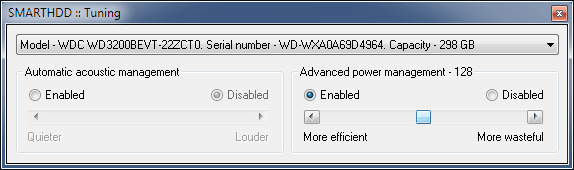
Usually, the difference in the productivity of average access time at the minimum and maximum value makes 5 ms, i.e. approximately 25%. The change of the AAM level keeps its operation going on even after the power supply turns off. In an idle mode, the main sources of noise are bearings of spindle motor and turbulence of air circulating with high speed in the hermetic block. It is impossible to get rid of this type of noise since the rate of rotation of magnetic disks is constant.